The Hollow Stage
In this theater of false dualities, one observer transcends binary thinking and chooses wholeness.
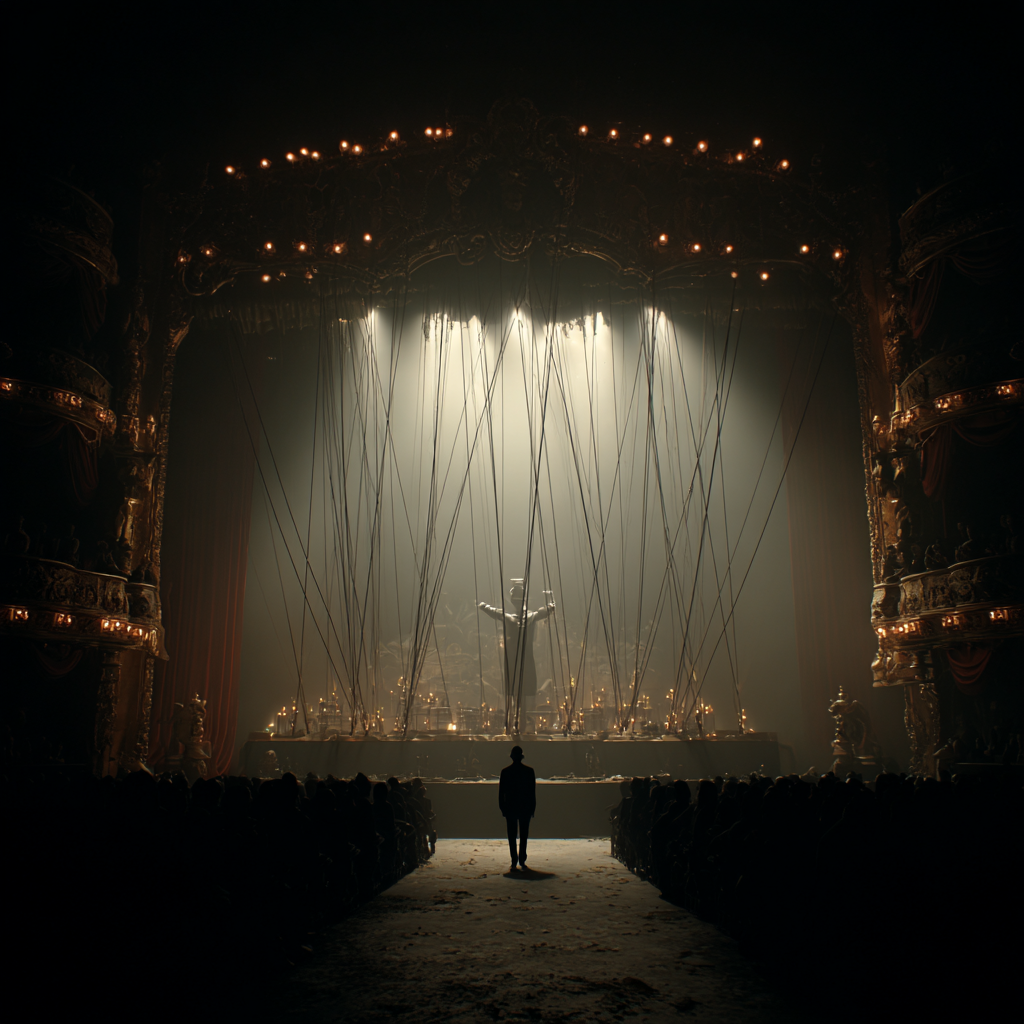
Table of Content
In the vast assembly hall where echoes breed, a thousand faces wear a single mask; The Leader speaks, and speaking, plants the seeds of enemies that dance upon his strings.
"They're coming for us!" cries the hollow man, his chest a mirror, heart an empty space. With one hand he creates what the other hand pretends to shield us from with false embrace.
The crowd nods yes to stones for bread, to burning books because the harvest came, hypnotized by certainty, not what is said; the rhythm matters more than reason's claim.
He needs the Other like he needs to breathe; without an enemy, he'd cease to be. Not man, but process, weaving to deceive, forever splitting "them" from "we."
Yet in the fevered mass, one pair of eyes stops watching the performance, looks around, sees puppet strings where others see the skies, sees hollow space where souls should sound.
No grand rebellion, no heroic stand; he rises, walks into the night. Not joining sides, not raising angry hand, but leaving the theater and its false light.
The Leader cannot follow where he goes; beyond the stage, there is no script to read. One person, seeing through the hollow show, chooses the darkness that is whole indeed.
For every empire built on phantom fear, for every chief who points beyond the fire near, it takes just one who stops to truly hear the silence where the strings betray the liar.
The parable complete in four short lines: One watches, reflects, and sees the hollow core. Sees fear creates the very thing it finds. Then chooses something undefined, and forever more.
Author
Sign up for The (all) Unknowing newsletters.
Stay up to date with curated collection of our top stories.